Installation

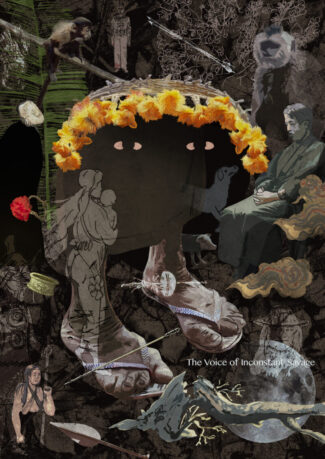
The Voice of Inconstant Savage
Commissioned for the Engawa – Japanese Contemporary Art Season programme organized by Calouste Gulbenkian Museum's Modern Art Center, The Voice of Inconstant Savage is an immersive installation that superimposes a prayer inspired by the story of a 16th-century Portuguese missionary, a chant from a Kakure-Kirishitan (hidden Christians) prayer – a religion rooted in Nagasaki Prefecture –, a chant from the Karawara spirits of the Awá indigenous people – who live in the Amazon rainforest – and a chorus of Western Gregorian chant. Morinaga questions the position of the aesthetics of inconstancy in relation to the discourse of the “savage” that modern society confronts.

Field recordings

Sombat Simla: Master Of Bamboo Mouth Organ
Simla is known in Thailand as one of the greatest living players of the khene, the ancient bamboo mouth organ particularly associated with Laos but found throughout East and Southeast Asia. His virtuosic and endlessly inventive renditions of traditional and popular songs have earned him the title ‘the god of khene’, and he is known for his innovative techniques and ability to mimic other instruments and non-musical sound, including, as a writer for the Bangkok Post describes, ‘the sound of a train journey, complete with traffic crossings and the call of barbecue chicken vendors’.

Cinema

The Cloud of Unknowing
Ho Tzu Nyen’s multichannel video installation The Cloud of Unknowing (2011) explores the expansive subject of the representation of the elusive and amorphous cloud. Inspired by philosopher Hubert Damisch’s thesis on the form’s aesthetics and symbolism, A Theory of /Cloud/: Toward a History of Painting, first published in French in 1972, Ho’s work incorporates a set of eight compartmentalized vignettes, each centered on a character that stands for the cloud’s representation in historically significant Western European artworks by artists including Caravaggio, Francisco de Zurbarán, Antonio da Correggio, Giovanni Lorenzo Bernini, Andrea Mantegna, and René Magritte, as well as the Eastern landscapes of Mi Fu and Wen Zhengming. This incorporation and blending of cultural, historical, and philosophical references, both Eastern and Western, is prevalent in Ho’s practice, which references painting (EARTH, 2009), pop music (The Bohemian Rhapsody Project, 2006), literature (The King Lear Project, 2008) and philosophy (Zarathustra: A Film for Everyone and No One, 2009).

Field recordings

He Xiu Dong(Dongba Shaman) [Lijiang, China]
世界で最も少数民族が多いと言われている雲南省(中国)は麗江に居住するナシ族の宗教聖職者ことドンバ(Dongba)、ホー・シュー・ドン(He Xiu Dong)による経典の詠唱と儀礼を数回にわたって現地録音した作品です。ドンバはナシ族特有の象形文字による経典を詠唱し、儀式を通じて精霊と対話する特異な存在です。森永は、現地での聞きこみ調査を行いながらトンバのホー・シュー・ドンと出会い、屋外・室内・自宅の3回にわたりレコーディングを行いました。

Field recordings

Yasuhiro Morinaga presents Field Recording Series Endah Laras [Surakarta, Indonesia]
Endah Laras [Surakarta, Indonesia]
インドネシアの大衆音楽クロンチョンの歌い手として、現地では「ジャワの歌姫」と呼ばれているエンダ・ララスの楽曲をフィールド・レコーディングした作品です。彼女の華麗なる歌声からインスピレーションを得た森永は、「エンダにとって最も思い入れのある場所」で録音を行おうと提案し、今は亡きエンダの父親が所有していたワヤン・クリ(影絵)の練習場をロケーションとして選び、フィールド・レコーディングしたアルバムになっています。